
Gum Rosin Grade WW - China
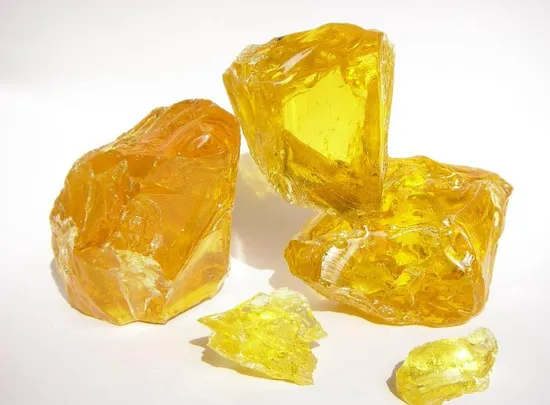
Gum Rosin Grade WW is a transparent, pale to almost colorless resin extracted from pine trees, primarily the slash pine (Pinus elliottii) and longleaf pine (Pinus palustris). The "Water White" designation denotes a high degree of purity, resulting in a resin with minimal coloration. It is obtained through the process of tapping living pine trees and collecting the exuded resin.
Ordering
Specifications
| Country | China |
|---|---|
| IUPAC Name | (4aR)-1,4a-dimethyl-7-propan-2-yl-2,3,4,4b,5,6,10,10a-octahydrophenanthrene-1-carboxylic acid |
| CAS Number | 8050-09-7 |
| HS Code | 3806.10.00 |
| Formula | C20H30O2 |
| Appearance | Yellow Brown Cristal |
| Common Names | Gum Rosin Grade WW |
| Packaging | (225 kg Galvanized Iron Drum), (25 kg Net Kraft Paper Bag) |
Applications
Cosmetics Industry
The residue left after the distillation of the volatile oil of oleoresin
obtained from Pinus palustris and other species of Pinaceae. It is less
and less used in cosmetics for the benefit of its esters, in cosmetics.
It is authorized in Bio.
Adhesive Agent
Rosin, or more correctly rosin acid, is one of the oldest raw materials
for the adhesives industry, either as such or converted to derivatives.
Three sources of rosin are used for resin manufacture, gum rosin, wood
rosin and tall oil rosin, all generated from the pine tree.
Pulp and Paper Industry
Rosin is added to paper pulp to increase resistance to water and other
liquids. Alum (short for aluminum sulfate) is added to help the rosin
adhere to the paper fibers.
Paint and Coating Material
It is semi-transparent and varies in color from yellow to black. At room
temperature rosin is brittle, but it melts at stove-top temperatures. It
chiefly consists of different resin acids, especially abietic acid.